The ICPC Annual General Meeting of Members

The ICPC held its Annual General Meeting of Members on October 21st, 2021, in Nice, during the European Forum for Urban Security (Efus)’s conference “Security, Democracy and Cities”. All members were invited to take part in person or online. The Director General presented the highlights of the ICPC’s last two years, the new reports published, news of its network, its participation in international online events, and the challenges posed by the COVID-19 pandemic. The meeting was also a chance to present the organization’s plan of action in accordance with the strategic orientations of the coming years.

The assembly also reviewed the ICPC’s financial and annual statements for 2019 and 2020 and elected new members of the Board of Directors. To see the current Board of Directors: https://cipc-icpc.org/en/board-of-directors/.

Launch of the RÉSAL’s community of practice

The ICPC had the pleasure of organizing the launch of a series of workshops and activities offered by the Réseau d’échange et de soutien aux actions locales (Network for exchange and local action support, RÉSAL) as part of the development of its community of practice. Supported by the city of Montreal, this process aims to provide a bigger space for the sharing knowledge and experience around different forms of violence committed and suffered by youth aged 12 to 25. It is specially targeted at community workers in the North-East of the island of Montreal to equip them to deal with various problems met in their daily activities.

For the first theme of the fall on violence prevention in street gangs, the local stakeholders were able to attend a day-long workshop given by René-André Brisebois, instructor and lecturer at the University of Montreal for the last decade, and Professional Coordinator of the Institut universitaire jeunes en difficulté (IUJD)’s Center of Expertise.

Aiming to deconstruct common prejudices around street gangs and criminalized youth networks, the workshop highlighted some key aspects:

  • The ethnicized dimension of the term “street gang” and the complex reality of this phenomenon;
  • The social and personal characteristics pf gang members, as well as the affiliation and disaffiliation trajectories of youth within these groups;
  • The most effective approaches, preventive actions, and interventions for preventing the joining of gangs and for reducing related crimes.

Overall, around 15 participants were present at the workshop given at the BAnQ Grande bibliothèque and all sanitary recommendations were followed. This first workshop will be followed by clinical supervision activities this fall to delve deeper into the issues raised from the fieldworkers’ experience.

More information about other training sessions offered:

Sexual violence prevention

Online hate prevention

Street work and youth intervention

These training sessions were carried out with the financial support of the City of Montreal.

The ICPC takes part in a CMNCP conference on urban safety

On Tuesday, October 5th, the ICPC was on a panel as part of the virtual conference: “Community Safety in the Midst of a Global Pandemic: Who Are We Leaving Behind?” organized by the Canadian Municipal Network on Crime Prevention (CMNCP), an ICPC partner, that took place from October 4th to 6th, 2021, gathering nearly 80 participants.

The session in which the ICPC took part was called “Eradicating Violence: Essentials That Do Not Leave People Behind” and discussed community safety and crime prevention, as well as an evidence-based and inclusive approach to violence prevention. Questions discussed included:

  • What are the evidence-based solutions that should be more used in Canada?
  • How to implement these solutions?
  • What can we learn from cities that succeeded in making changes necessary to succeed?
  • Can we learn from cities like London, UK, that applied a public health model to violence prevention?

The ICPC would like to thank the CMNCP for the invitation.

The ICPC participates in an SPVM workshop on police intervention policy

On Tuesday September 28th, the ICPC took part in a workshop lead by the Service de police de la Ville de Montréal (Montreal police department, SPVM) on police intervention policy. Adopted in July 2020, the Politique sur les interpellations policières marks an important cultural turning point and provides a framework for the organization’s intervention practices. The SPVM is the first police force in Quebec to implement such a policy.

Among the issues discussed at the workshop, a focus was put on the following themes:

  • The difference between social interactions, interventions, police stops, custody for questioning, and arrests;
  • Legal issues related to various police practices;
  • The application context for and the issues related to the newly implemented intervention form.

This workshop aimed to demystify police intervention practices and to educate the public on the practical implications of the new policy in the SPVM. We thank the SPVM and the Borough of Saint-Léonard for inviting us to take part in this workshop and to exchange with local actors.

The ICPC participates in a conference on urban safety in a pandemic

The ICPC is invited to participate in the virtual conference “Community Safety in the Midst of a Global Pandemic: Who Are We leaving behind?” organized by the Canadian Municipal Network on Crime Prevention (CMNCP), an ICPC partner. The ICPC will be part of a panel called “Eradicating Violence: Essentials That Do Not Leave People Behind” on October 5, from 11 AM to 12:30 PM (EST).

This conference will be held from October 4 to 6, 2021, and aims to support urban and rural municipalities and indigenous communities, organizations, groups, and individuals in their crime prevention and urban safety efforts in the communities and areas where they live. The conference will address many questions including the notion of safety, the COVID-19 pandemic’s effects on urban safety, links between systemic issues such as racism or social justice, and urban safety and the prevention of hate and violent extremism. The deadline for signing up is October 1, 2021.

Learn more and sign up: https://www.eventbrite.ca/e/cmncp-2021-virtual-conference-tickets-160796082411

New Guide – DataJam Against Exploitation: Participant Handbook

As part of the DataJam Against Exploitation 2021, the first online innovation competition in Canada, a “Participant Handbook” was developed and published. The event, financed by the Government of Canada, was organized in partnership between the ICPC, Fundación Pasos Libres, IBM, and the UNODC.

The handbook was adapted and translated collaboratively by the Fundación Pasos Libres, the ICPC and the UNODC from an earlier version published by Fundación Pasos Libres, with the support of IBM Corporate Social Responsibility, as part of the training materials for the DataJam Pasos Libres Online 2020, the first international contest of its kind, also on human trafficking.

The DataJam Against exploitation, held in May 2021, aimed to develop technological solutions to spot and fight human trafficking in Canada, especially the trafficking of youth, indigenous people, and members of the LGBTQI+ community. The contest also hoped to increase public awareness of human trafficking, to improve participants knowledge and resources, and to further intersectoral and interdisciplinary collaboration. The handbook contains three explanatory modules offering the reader an introduction to human trafficking in Canada and related issues, an overview of data’s importance in the fight against this crime, and case studies.

The first module, Introduction to Human Trafficking, discusses means of exploitation, risk factors, and recruitment and control methods. It also takes a brief look at different forms of legislation aimed at the prevention of human trafficking.

The second module, Human Trafficking and Data, explores the importance of data in the fight against human trafficking. It gives a few examples of key industries and compelling data as well as certain data security and protection considerations.

The last module, Case Studies / Cases of Success, is on three organizations and initiatives that used the power of data and collaboration to prevent and fight human trafficking.

Download: DataJam Against Exploitation: Participant Handbook

Webinar series on crime prevention and analysis

The ICPC is co-organizing a webinar series this year aiming to further the international conversation on crime prevention and analysis. The other organizing parties are the Department of Public security of the Organization of American States, The International Association of Crime Analysts, and Alberto Hurtado University’s Faculty of Law. The latest edition that took place in June focused on crime prevention and analysis in urban areas of Latin America. A variety of panelists exchanged their knowledge of and innovations in crime prevention on local and community levels. Subjects covered include information use, criminological analysis, and key decisions in safety, crime, and violence interventions. A focus was put on issues concerning vulnerable populations and lands.

The ICPC participates in International Prison Innovation Week

On June 24th, the ICPC presented at International Prison Innovation Week organized in Chile by our partner, the Coinserta network. The ICPC’s presentation, “Developing an Intervention and Prevention Response to Radicalization Leading to Violence in the French Probation System”, was on its research-action developed in 2016 to prevent violent extremism in the French probation system. The presentation aimed to introduce a radicalization prevention tool, specifically for a custodial setting, that could be adapted to the needs of indigenous communities in Chile.

TIJ celebrates it’s 10th anniversary

This year, on June 13th, the Thailand Institute of Justice (TIJ) celebrated its 10th anniversary. The ICPC is pleased to be among the TIJ’s collaborators. It is an institution that has been leading Thailand’s efforts in the field of criminal justice, reintegration, and the rule of law for the past 10 years, and is a fellow member of the United Nations Crime Prevention and Criminal Justice Programme Network Institutes (PNI).

“It is important for us to acknowledge the work of this renowned research institution that promotes a community of justice fostering human rights principles and the rule of law. The extensive involvement of the TIJ’s members has led this institute to become a key player in crime prevention and criminal justice strategies on a global scale, and by fostering important partnerships, it has succeeded in evolving and innovating emerging trends in crime prevention and criminal justice. We are confident that the TIJ will continue to fulfill its mission for many years to come.” – Ann Champoux, Director General at the ICPC

For more information, see the TIJ’s publication: Growing Bright.

The ICPC invited to a conversation on urban security

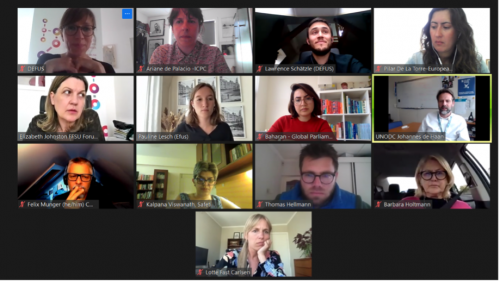
On June 8th, the ICPC was invited by the European Forum for Urban Safety (Efus) and by the Canadian Municipal Network on Crime Prevention (CMNCP) to take part in an informal conversation on urban safety. The main subjects discussed were each of the invited organizations challenges in the face of COVID-19, their on-going projects, and their up-coming events.

Among the attendees were the United Nations Office on Drugs and Crime (UNODC) and the United Nations Human Settlement Programme (UN-Habitat), both ICPC members.