A Report to Better Understand Crime in Low-Rent Housing and Support Local Action

As part of a mandate entrusted by the City of Montréal, the International Centre for the Prevention of Crime has published the report État des lieux de la criminalité dans et aux alentours des HLM – agglomération de Montréal (Crime In and Around Low-Rent Housing (HLM) in the Greater Montréal Area). This work reflects a commitment by the city of Montréal to strengthen local analytical capacity in urban safety, while taking into account the social and territorial realities specific to low-income residential environments.

Between 2018 and 2022, more than 9,300 criminal cases were recorded within the perimeter of low-income housing units. While property crimes are the most frequent, crimes against persons increased by 38%, with women and seniors being particularly affected. These dynamics highlight the need for interventions tailored to social vulnerabilities, precarious living conditions, and relational contexts.

Conducted with the support of the ministère de la Sécurité publique du Québec (Québec Ministry of Public Security), the report offers concrete recommendations to enhance community safety, improve social cohesion, and support public housing residents across the Montréal metropolitan area.

Read the full report (in French)

A Statistical Report of Crime in the Greater Montréal Area

The International Centre for the Prevention of Crime has published its report Statistical Report of Crime in the Greater Montréal Area, produced with the support of the ministère de la Sécurité publique du Québec (Québec Ministry of Public Security) and the City of Montréal. This local safety assessment presents a detailed overview of reported offences between 2018 and 2022, based on data from the Uniform Crime Reporting Survey (UCR 2.2). 

More than 358,000 criminal cases were recorded, including a significant increase in property-related offences (+12%) and crimes against persons (+34%). Vehicle theft, fraud, sexual offences, and domestic violence are among the key issues identified. 

This report aims to equip public authorities and local partners with evidence-based insights for strategic urban safety planning. It offers practical recommendations to strengthen prevention efforts, enhance safety in public and residential spaces, and better support vulnerable populations.

Read the full report (in French)

New Report: Analysis of Crimes Related to the Non-Consensual Distribution of Intimate Images in the Greater Montréal Area

The International Centre for the Prevention of Crime (ICPC) has published its report Analysis of Crimes Related to the Non-Consensual Distribution of Intimate Images in the Greater Montréal Area. Conducted with the support of the ministère de la Sécurité publique du Québec (Québec Ministry of Public Security) and the City of Montréal, this report is the first comprehensive study on this rapidly growing phenomenon in the Greater Montreal Area.

Based on police data from the Uniform Crime Reporting Survey (UCR 2.2) (2018–2022), the report highlights the gender-based dynamics of these offences, which primarily affect young women aged 12 to 30. It shows that these crimes often occur within intimate relationships and extend certain forms of domestic and relational violence into cyberspace. 

Commissioned by the City of Montréal, the ICPC puts forward concrete recommendations to strengthen prevention, victim support, and intersectoral collaboration. Moreover, this report serves as a strategic tool for policymakers, educational institutions, community organizations, and digital platforms.

Read the full report (in French)

A new report to document and prevent the victimization of women and girls in Montréal

The International Centre for the Prevention of Crime (ICPC) has released a new report entitled Vue d’ensemble de la victimisation des femmes et des filles dans l’agglomération de Montréal.

Drawing on police data from Québec’s Ministry of Public Security, the report highlights a troubling rise in the victimization of women and girls between 2018 and 2022, particularly assaults. It also sheds light on significant territorial and generational disparities, as well as the high prevalence of violence committed within close relational contexts.

To better guide public policy and local interventions, the report puts forward a series of strategic recommendations. These include developing safe and inclusive public spaces, strengthening support for victims in private settings, intensifying prevention efforts targeting adolescent girls, and improving gender-based data collection.

Produced by the ICPC in collaboration with the City of Montréal, this work aims to provide public authorities, researchers, and frontline stakeholders with tools to implement sustainable and tailored actions in the field of urban safety.

Read the full report (available in French only)

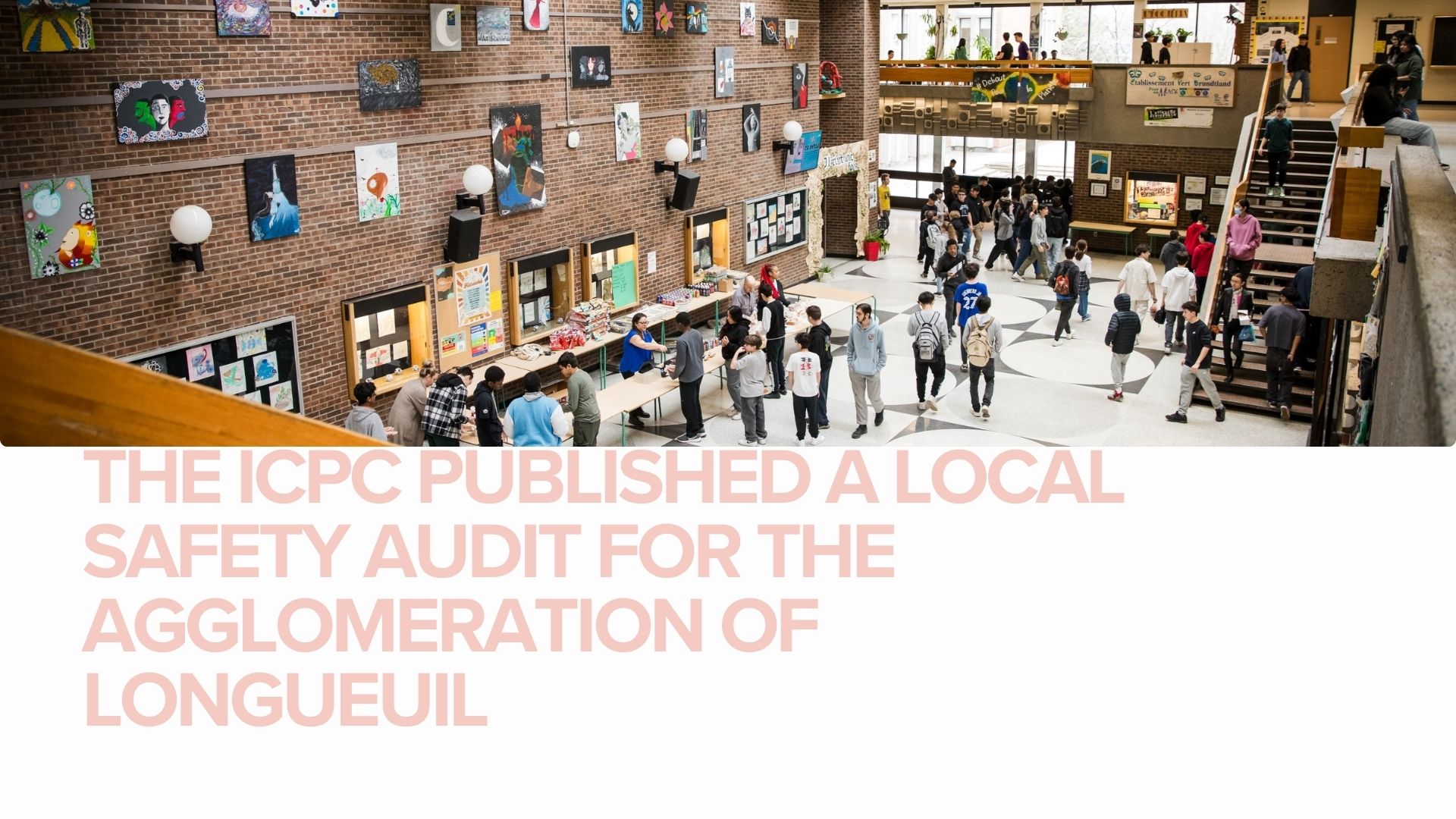
The ICPC published its local safety audit for the agglomeration of Longueuil

An increasing rate of crimes against the person was observed in the Longueuil agglomeration between 2018 and 2022. Also, over the same period, it was noted that young women were the most numerous victims of crime in private spaces, and that young people aged 12 to 17 accounted for the highest number of victims in schools. 

These examples of analyzed observations of crime in the agglomeration have encouraged the need to strengthen collaboration between the various local stakeholders, such as the police, public institutions and community organizations, to put in place coordinated and effective prevention measures. Through the Government of Canada’s Building Safer Communities Fund (BSCF), contributed in part to the Government of Quebec under an agreement, the City of Longueuil appointed the ICPC to support it in conducting a local safety audit. The purpose of this report is to provide an overview of safety among youth in the Longueuil agglomeration and to encourage community participation in safety issues.  

Achieved through a collaborative approach favouring positive and sustainable transformation as well as through space syntax approach, the report provides a quantitative analysis based on police data provided by the Urban agglomeration of Longueuil Police Service. The report also presents a qualitative analysis, which was carried out in collaboration with local stakeholders, involving consultative activities with young people in the territory. Finally, the study features concrete recommendations and solutions, appropriate and adapted to local realities, to strengthen and create safer public spaces. 

The report is divided into 4 sections:  

  • An analytical framework, which lays the foundation for the study, addressing urban safety and the space syntax. It also points out the limitations of using police data and quantitative analysis;   
  • A portrait of crime in living spaces, which provides an overview of crime in the Longueuil agglomeration, detailing alleged perpetrators and victims by crime location, relationships between victims and perpetrators, and the temporality and geography of the crimes, etc.;  
  • The results of the on-site survey, such as risk factors and the feeling of safety in public spaces in the agglomeration, exploring issues relating to social cohabitation, the school environment, family life and parenting, cyber-violence, etc.;  
  • Conclusions and possible solutions, in collaboration with youths and local stakeholders, to improve safety, strengthen human and financial resources, coordinate organizational structures, and develop protection strategies for private and public spaces, such as schools and cyberspace.

Read the report here (available in French only)

Read the press release (available in French only)

ICPC publishes its local safety audit on girls, women and elders for the Villeray—Saint-Michel—Parc-Extension borough

Various types of violence affect girls, women and elders. To name only one, it was revealed that up to 78% of women have undergone an act of cyberviolence from their partner or from a former partner and that 47% of younger women, of which 75% were adolescents, had undergone acts of cyberviolence during an intimate relationship in the last year (Gauvreau, 2022; Fernet et al., 2019).

The Villeray—Saint-Michel—Parc-Extension borough, in Montreal, has mandated the International Centre for the Prevention of Crime (ICPC) to illustrate the state of safety on its territory. A larger focus was put on incidents involving girls and women of all ages. The objective was to target the main issues, as much qualitative as quantitative, to issue recommendations regarding initiatives that could be put in place to better the situation.

This audit presents the issue in many different ways depending on the targeted age group, be it adolescents (12-17), young women (18-25), adult women (24-64) and elders (65 and over), as well as recommendations for action and prevention. Issues include sexual, psychological and interpersonal violence, as well as cyber-violence and abuse.

The LSA is in line with the plan announced by VSP in 2022, which made women’s safety a priority for the borough.

Media coverage (in French only) :

  • March 20, 2024, LebulletinFR: Violence faite aux femmes: un rapport accablant rendu public – Le Journal de Montréal. Read the article.
  • October 11, 2023, Tout un matin, Radio-Canada : Rattrapage du mercredi 11 oct. 2023 : Évacuations des Canadiens et Canadiennes en Israël, et conversion d’une église en chambre froide Listen to the interview (from 0:00 to 1:50)
  • October 10, 2023, Le 15-18, Radio-Canada : Des activités réservées aux filles dans Saint-Michel. Listen to the interview 
  • July 24 2023, Journal Métro : Villeray–Saint-Michel–Parc-Extension: 3 M$ pour soutenir les jeunes et les femmes. Read the article
  • July 6 2023, EST Médias : VSP finance des projets pour les jeunes et leurs parents. Read the article 
  • June 23 2023, Le Journal de Montréal : Violence faite aux femmes: un rapport accablant rendu public. Read the article  
  • June 23 2023, Le Journal de Québec : Violence faite aux femmes: un rapport accablant rendu public. Read the article
  • June 22 2023, 98,5 : Villeray-Saint-Michel-Parc-Extension. Le sentiment d’insécurité chez les femmes. Listen to the interview 

Read the report here (synthesized version in French)

Read the report here (complete version in French)

The ICPC published its second report on violence committed and suffered by young people in the Greater Montreal area


In 2022, several acts of violence involving young victims and alleged perpetrators were committed in the cities and boroughs of Greater Montreal. Young adults aged between 18 and 25 represent the majority of victims, but all age groups (11 and under and 12 to 17) are concerned.

It is in this context, and in light of a growing concern among Montrealers about feelings of insecurity, that this report offers an in-depth analysis of the various acts of violence involving young people in Montreal in recent years, highlighting the key factors that have influenced these situations, in particular the COVID-19 pandemic, cyber-violence, and gun violence. Its main objective is to draw up a detailed assessment of the current situation and to make recommendations for the prevention of violence experienced and perpetrated by youth in the city.

This report focuses on four main themes:

  • A descriptive analysis of the crimes against the person between 2015 and 2019
  • Analysis of the living spaces frequented by youth
  • Cybercrime
  • Issues related to criminal acts involving firearms, edged weapons, and improvised weapons as well as young people

Read the report here (available in French only)

ICPC has published a review of the literature and practices for the prevention of armed violence

Gun violence is on the rise in the Montreal metropolitan area, but also throughout Quebec (Larin 2022), and cold weapon violence is still common. However, several tragic events involving firearms have compelled the Quebec government to invest in the fight against this type of violence.

This review of literature and practice is part of these efforts to better understand the phenomenon of armed violence. It also seeks to share knowledge and experiences from measures put in place around the world to curb violence. However, armed violence is a complex phenomenon that involves more than one issue. Therefore, it is important to adopt the appropriate prevention strategies depending on the context in which armed violence is addressed in order to intervene in a comprehensive and targeted manner.

This report presents four issues that may result in weapon-related acts: 

  • Suicide and self-inflicted violence;
  • Armed violence among delinquent or criminalized youth groups;
  • Intimate partner violence;
  • Incidents related to violent extremism.

This report provides insight and understanding of crime data collected under the Quebec Department of Public Safety's Uniform Crime Reporting (UCR 2.2) rules from 2015 to 2020.  

Read the report here (in French)

Presentation of two reports to the Service de police de la Ville de Montréal

Since the beginning of the pandemic, the City of Montreal has experienced a sharp increase in certain firearm-related crimes, most of which involve young people. This issue, which must be addressed through a multi-sectoral approach and which must benefit from a concerted vision, is of particular concern to the Service de police de la Ville de Montréal (SPVM). The SPVM, therefore, contacted the International Centre for the Prevention of Crime in order to develop its integrated plan to combat gun violence and improve its practices.

On October 27th, ICPC was invited to present highlights of two recently published reports addressing different issues related to gun violence, the first one focusing on the glorification of firearms on social media and the second one on the prevention of gun violence.

This meeting was an opportunity for the team to share best practices from the literature, but also to exchange with 14 members of the SPVM’s internal committee of experts on the issue of the rise of gun-related violence in Montreal, on the initiatives to be implemented at the community level as well as on social media in order to prevent such violence.  

Thank you to the Service de police de la Ville de Montréal for the invitation.

Glorification of firearms on social media and prevention best practices: an overview

As part of the evaluation of public policies on street gangs and firearms, and in order to act proactively to fight crime, the Quebec Ministry of Public Safety mandated the International Centre for the Prevention of Crime to review the knowledge related to the glorification of firearms on social networks.  

 Consequently, this report consists of a recension of the literature divided into two main parts: 

1) Understanding the phenomenon of the presence and glorification of firearms on social networks;  

2) The identification of best preventive practices (implemented in the media and on social networks) to counter gun violence. 

The main objective of this report is to identify the best ways to reach young people on social networks in order to counter gun violence and raise awareness of the issues involved.  

Read the report (only available in French)