On June 29, the ICPC was pleased to participate in the webinar “Preventing Social Polarization and Radicalization in Education and Beyond” organized by its partner the Canadian Municipal Network on Crime Prevention (CMNCP).
During this webinar, nearly sixty participants, such as practicioners, school professionals and members of the RMCPC community, held a discussion on”the role of education professionals in preventing social polarization and radicalization leading to violence”. The purpose of this webinar was to present an overview of the study’s main findings and the recommendations that arose from the 2-year project funded by Public Safety Canada on “Examining the role of school professionals in preventing social polarization and radicalization leading to violence”. As a result, a number of issues relating to the prevention of radicalization, violence, social polarization and cyberspace in Canadian schools were addressed.
This event was an opportunity for the ICPC to learn more about international practices regarding the prevention of radicalization leading to violence, as well as issues that people working in schools may encounter. These were presented by CPN-PREV, CIVIX, Strong Cities Network and Foundation for a path forward.
In Montreal today, one issue is causing concern: gun-related violence. Since the COVID-19 pandemic, a troubling trend seems to be emerging: an increase in incidents involving firearms in the heart of the city, with the majority of victims under the age of 25. This growing concern has led the International Centre for the Prevention of Crime to carry out an in-depth study to fully grasp the phenomenon and understand its players, thanks to the financial support of the Quebec Ministry of Public Security.
By examining these events, the ICPC aims to provide essential elements for a better understanding of this complex reality and to find ways of dealing with it.
Analyzing incidents involving a firearm from 2015 to 2020, which represent more than 924 criminal cases recorded by the Montreal City Police Service, the primary aim of this report is to shed light on the context in which firearms are used in the Greater Montreal area, based on the criminal offence codes used.
The report is therefore as follows:
A detailed analysis of general trends in the form of figures.
A profile of the alleged perpetrators and victims, as well as the links between them, and the places and times of the incidents.
Various types of violence affect girls, women and elders. To name only one, it was revealed that up to 78% of women have undergone an act of cyberviolence from their partner or from a former partner and that 47% of younger women, of which 75% were adolescents, had undergone acts of cyberviolence during an intimate relationship in the last year (Gauvreau, 2022; Fernet et al., 2019).
The Villeray—Saint-Michel—Parc-Extension borough, in Montreal, has mandated the International Centre for the Prevention of Crime (ICPC) to illustrate the state of safety on its territory. A larger focus was put on incidents involving girls and women of all ages. The objective was to target the main issues, as much qualitative as quantitative, to issue recommendations regarding initiatives that could be put in place to better the situation.
This audit presents the issue in many different ways depending on the targeted age group, be it adolescents (12-17), young women (18-25), adult women (24-64) and elders (65 and over), as well as recommendations for action and prevention. Issues include sexual, psychological and interpersonal violence, as well as cyber-violence and abuse.
The LSA is in line with the plan announced by VSP in 2022, which made women’s safety a priority for the borough.
Media coverage (in French only) :
March 20, 2024, LebulletinFR: Violence faite aux femmes: un rapport accablant rendu public – Le Journal de Montréal.Read the article.
October 11, 2023, Tout un matin, Radio-Canada : Rattrapage du mercredi 11 oct. 2023 : Évacuations des Canadiens et Canadiennes en Israël, et conversion d’une église en chambre froide. Listen to the interview (from 0:00 to 1:50)
October 10, 2023, Le 15-18, Radio-Canada : Des activités réservées aux filles dans Saint-Michel.Listen to the interview
July 24 2023, Journal Métro : Villeray–Saint-Michel–Parc-Extension: 3 M$ pour soutenir les jeunes et les femmes. Read the article
July 6 2023, EST Médias : VSP finance des projets pour les jeunes et leurs parents.Read the article
June 23 2023, Le Journal de Montréal : Violence faite aux femmes: un rapport accablant rendu public.Read the article
June 23 2023, Le Journal de Québec : Violence faite aux femmes: un rapport accablant rendu public. Read the article
June 22 2023, 98,5 : Villeray-Saint-Michel-Parc-Extension. Le sentiment d’insécurité chez les femmes.Listen to the interview
In 2022, several acts of violence involving young victims and alleged perpetrators were committed in the cities and boroughs of Greater Montreal. Young adults aged between 18 and 25 represent the majority of victims, but all age groups (11 and under and 12 to 17) are concerned.
It is in this context, and in light of a growing concern among Montrealers about feelings of insecurity, that this report offers an in-depth analysis of the various acts of violence involving young people in Montreal in recent years, highlighting the key factors that have influenced these situations, in particular the COVID-19 pandemic, cyber-violence, and gun violence. Its main objective is to draw up a detailed assessment of the current situation and to make recommendations for the prevention of violence experienced and perpetrated by youth in the city.
This report focuses on four main themes:
A descriptive analysis of the crimes against the person between 2015 and 2019
Analysis of the living spaces frequented by youth
Cybercrime
Issues related to criminal acts involving firearms, edged weapons, and improvised weapons as well as young people
In response to growing concern among Montrealers about their sense of insecurity, the ICPC Urban Safety Laboratory is proud to announce the publication of its second report on violence committed and suffered by young people in the Greater Montreal area.
This report provides an in-depth analysis of the various acts of violence involving young people in Montreal in recent years, highlighting key factors that have influenced these situations, including the COVID-19 pandemic, cyber-violence, and gun violence.
The ICPC took part part in a seminar on “Crime Challenges in Ecuador 2023” held at the Central University of Ecuador on 12 June 2023. Organized by the Faculty of Jurisprudence, the Julio Endara Institute of Criminology at the Central University of Ecuador, and the Pan-American Studies Center (CEPEIGE), the seminar brought together various academic and institutional players from Ecuador and other Latin American countries to discuss different approaches, methods, and tools for preventing crime-related challenges. It was in this context that Oscar Figueroa, ICPC strategic consultant for Latin America, presented the mission, the network of members around the world, and the organization’s main current projects.
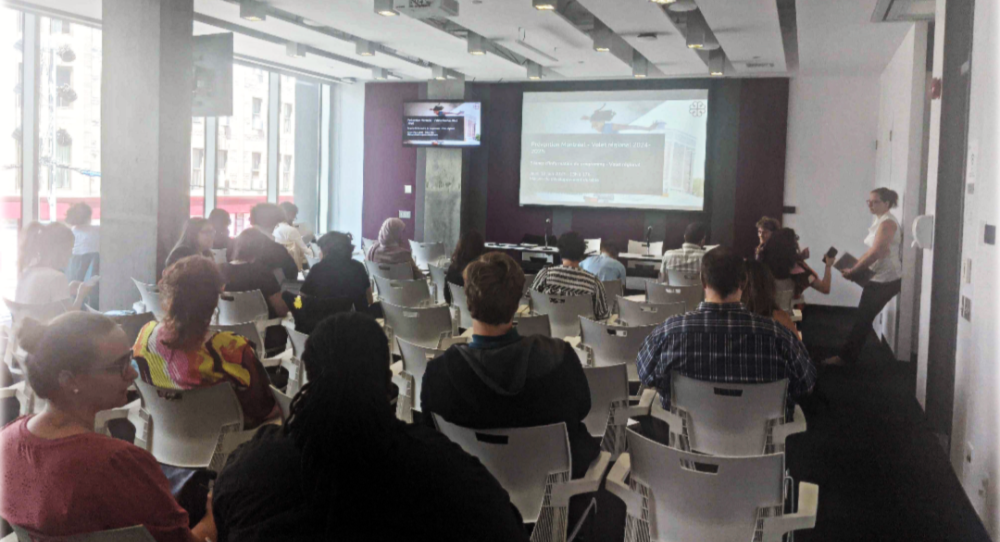
On 19 June 2023, at the Maison du développement durable, the ICPC was pleased to take part in an information session on the regional component (2023-2025) of the “Prévention Montréal” programme, presented by members of the City of Montréal’s Service de la diversité et de l’inclusion sociale (SDIS).
Created in 2020, Prévention Montréal helps to include citizens aged 0-30 at risk of exclusion and discrimination by mobilizing and consulting them. The programme helps to strengthen their civic and social commitment by helping them to learn more about their rights, but also by promoting their participation through sport, leisure and culture.
By adopting more inclusive public initiatives, notably through the ADS+ approach (Gender and Intersectionality Analysis), the City of Montreal hopes to promote high-quality, safe living environments in the future, particularly on the Internet, by raising awareness and preventing cyber-violence.
Aware of the importance of this initiative, the ICPC stressed the importance of launching a project specifically focused on “support for stakeholders”. This project would make it possible to support local participants, organisations and community initiatives that are actively working to prevent exclusion and discrimination in order to make an active contribution to building a society that is inclusive, egalitarian and respectful of all.
Erich Marks, Executive Director of the Crime Prevention Council of Lower Saxony and Ann ChampouxAnn Champoux and Jumma Assiago, Global Coordinator of the Safer Cities Programme at UN-Habitat
From June 12 to 13, 2023, Ann Champoux, Director General of the International Centre for the Prevention of Crime (ICPC), was in Mannheim, Germany, to take part in the 28th German Prevention Congress, which this year focused on crisis management and prevention. Among the nearly 2,000 participants, Ms. Champoux had the opportunity to meet with guests of honor, including community stakeholders, international organizations, and governments.
The ICPC was able to represent Quebec and Canada at the conference, highlighting its work through a video broadcast on the conference platform. In this video, ICPC analyst Janny Montinat illustrates the research work carried out on one of our reports published in 2022, which focused on the “Glorification of firearms on social media and prevention best practices: an overview”. During the event, Ann Champoux took part in various conferences and workshops covering topics such as women’s leadership in urban safety, managing feelings of insecurity, community policing planning, co-constructing safer neighborhoods, anticipating safety threats in public spaces and surveillance to achieve global safety and prevention goals.
The two days spent in Germany gave the ICPC the opportunity to make some valuable meetings. Ann Champoux met with Dr. Burkhard Hasenpusch, a former ICPC collaborator, an expert in many crime-related fields, and a great expert on the current situation in Germany. Among our members, we were able to strengthen our partnerships with important contacts such as Johannes de Haan, Head of Crime Prevention and Criminal Justice, Justice Section, UNODC, Jumma Assiago, Global Coordinator of UN-Habitat’s Safer Cities Program, Elizabeth Johnston, Executive Director of EFUS, Felix Munger, Executive Director of the Canadian Municipal Crime Prevention Network, Erich Marks, Executive Director of the German Foundation for Crime Prevention and Offender Support (DVS) and of the German Crime Prevention Congress, and former member of the ICPC Executive Committee, as well as representatives of Safe.brussels.
Representatives of the European Forum for Urban Security, UN-Habitat and the Canadian Municipal Crime Prevention Network
A very interesting meeting was also held with Dr. John Rook during his conference on the criminalization of poverty. Dr. Rook is a renowned expert in this field, founder and Director of the Canadian Poverty Institute at Ambrose University in Alberta, as well as President and CEO of the Simon House Recovery Center in Calgary. Their discussion helped deepen our knowledge about the social reintegration of ex-offenders and explore partnership opportunities between the ICPC and Alberta organizations.
We would like to thank the 28th German Prevention Congress and all our partners for the very positive exchanges that took place over the two days.
On Wednesday 14 June, the ICPC hosted in Montreal the President of the RC3D (Réseau pour la Coopération Décentralisée et le Développement Durable), Ms Angèle Bagnia, the President of the Associations des communes et villes unies du Cameroun pour le littoral (CUVC), Mr Valentin Epoupa Bossambo, and the Executive Director of the Société d’Assainissement du Cameroun (SECA), Ms Arlette Tchapoya, who is also a member of the Douala City Council.
The RC3D promotes international and inter-professional exchanges of experience and knowledge transfer, thus creating a platform that is unique in Africa and Canada.
The purpose of this meeting was, therefore, to renew the cooperation between our two entities following the COVID-19 pandemic, in order to evaluate the actions taken and to outline the possibilities for collaboration to prevent crime.



 In 2022, several acts of violence involving young victims and alleged perpetrators were committed in the cities and boroughs of Greater Montreal. Young adults aged between 18 and 25 represent the majority of victims, but all age groups (11 and under and 12 to 17) are concerned.