Training on Migratory Trauma and Youth Mental Health: A RÉSAL Initiative Coordinated by the ICPC 

Funded by the City of Montreal’s Prévention Montréal program, this training session which was held twice (on May 28 and June 19 2025), was attended by almost forty people,  focused on the influence of migratory trauma on the mental health of youth. It was led by Garine Papazian-Zohrabian, Professor in the Département de psychopédagogie et d’andragogie at the Université de Montréal and Scientific Director of the interdisciplinary research team on refugee and asylum-seeking families, Équipe de recherche interdisciplinaire sur les familles réfugiées et demandeuses d’asile (FRQSC). 

The training enabled participants to gain a better understanding of: 

  • The distinction between migration status and life journey; 
  • The impact of violence experienced before and after migration, as well as administrative barriers; 
  • Conditions that foster resilient support (psychosocial support, safe environments, the role of mentors). 

The discussions highlighted the urgent need for an integrated approach that combines psychosocial support, an appropriate legal framework, and actions promoting inclusion. 

The ICPC extends its sincere thanks to Garine Papazian-Zohrabian and all participants for the depth of their contributions and reflections. 
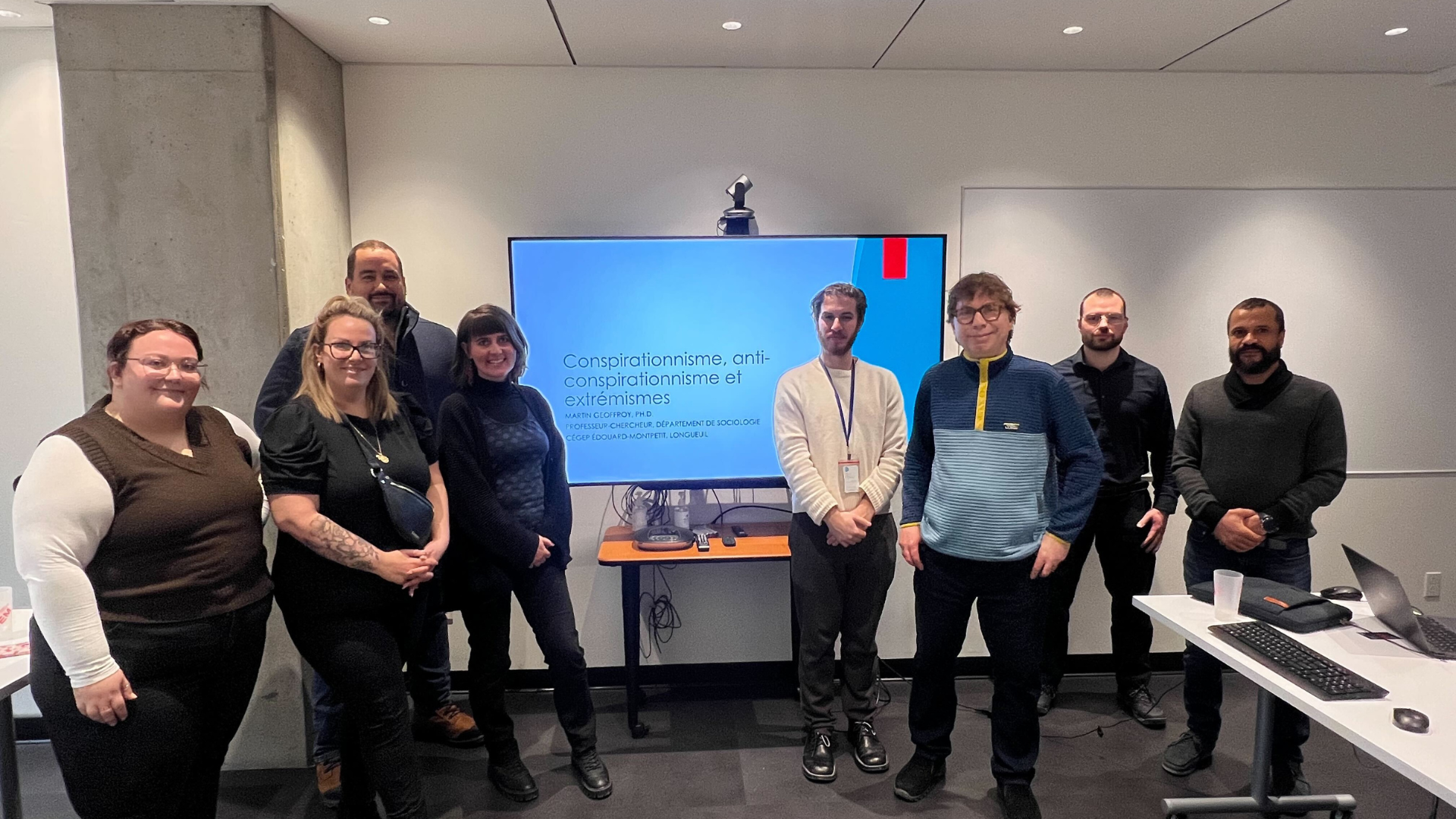
RÉSAL Offers a Powerful Training on Conspiracy Theories and the Far Right, coordinated by the ICPC

As part of the development of the capacity-building activities of the Réseau montréalais d’échange et de soutien aux initiatives locales (RÉSAL) for the winter of 2025, the ICPC, as a coordinating member, organised an in-person training session on April 11. 

Funded by the City of Montreal’s Prévention Montréal programme, the event focused on ‘Complotism, anti-complotism and the far right’, and was led by Martin Geoffroy, professor and researcher in sociology at Cégep Édouard-Montpetit and founder of the Centre d’expertise et de formation sur les intégrismes religieux (CEFIR). 

Participants explored in depth a crucial societal challenge: how conspiracy theories are gaining ground and how extremist movements exploit them. 

Key elements of the training included: 

✔ Decoding the mechanisms behind conspiracy theories, particularly those related to COVID-19 health measures, and their influence on public discourse.
✔ Understanding the psychosocial factors that lead people to embrace these narratives, often rooted in ideological beliefs rather than facts.
✔ Unpacking the strategies used by far-right groups to leverage conspiracy thinking in order to undermine democratic institutions.
✔ Practicing concrete techniques in an interactive workshop to engage effectively with those who hold such beliefs. 

Why did this training stand out? 

In the face of growing distrust in institutions and increasing polarization, understanding the workings of conspiracy discourse is essential for social workers, educators, and community professionals. 

We warmly thank Martin Geoffroy and all participants for their stimulating discussions and thoughtful insights! 

ICPC Launches Pan-Canadian Study on Public Transit Safety

The International Centre for the Prevention of Crime (ICPC) has launched a large-scale study to analyze public transit safety issues across Canada. The initiative will focus on five major cities: Montreal, Toronto, Ottawa, Calgary, and Edmonton. Its objective is to examine the safety challenges faced by both users and transit staff—factors that directly impact passenger well-being, ridership levels, employee retention, and the reputation of transit agencies. Certain groups, including women, persons with disabilities, and marginalized communities, are especially vulnerable to various forms of violence and insecurity.

A Field-Based Approach to Tailored Solutions

The study will be carried out using a range of methods:

  • Document review: analysis of existing literature and municipal policies
  • Key informant interviews: with stakeholders in transit and public safety
  • Exploratory walks: observation and on-site discussions with transit users representing diverse backgrounds

Each city will be the subject of a summary report, with a final publication compiling best practices and proposed solutions from across the country.

A Societal Challenge: Safe Mobility for All

By examining the entire journey of transit users—including vehicles, stations, waiting areas, and adjacent public spaces—this study aims to identify tangible solutions to improve everyone’s sense of safety.

An Action-Oriented Initiative

The study’s findings will support municipalities, transit agencies, and community organizations in developing preventive measures tailored to local realities.

With this initiative, the ICPC reaffirms its commitment to safer, more inclusive cities—where everyone can move around with confidence.

This study is made possible with financial support from the Government of Canada.