
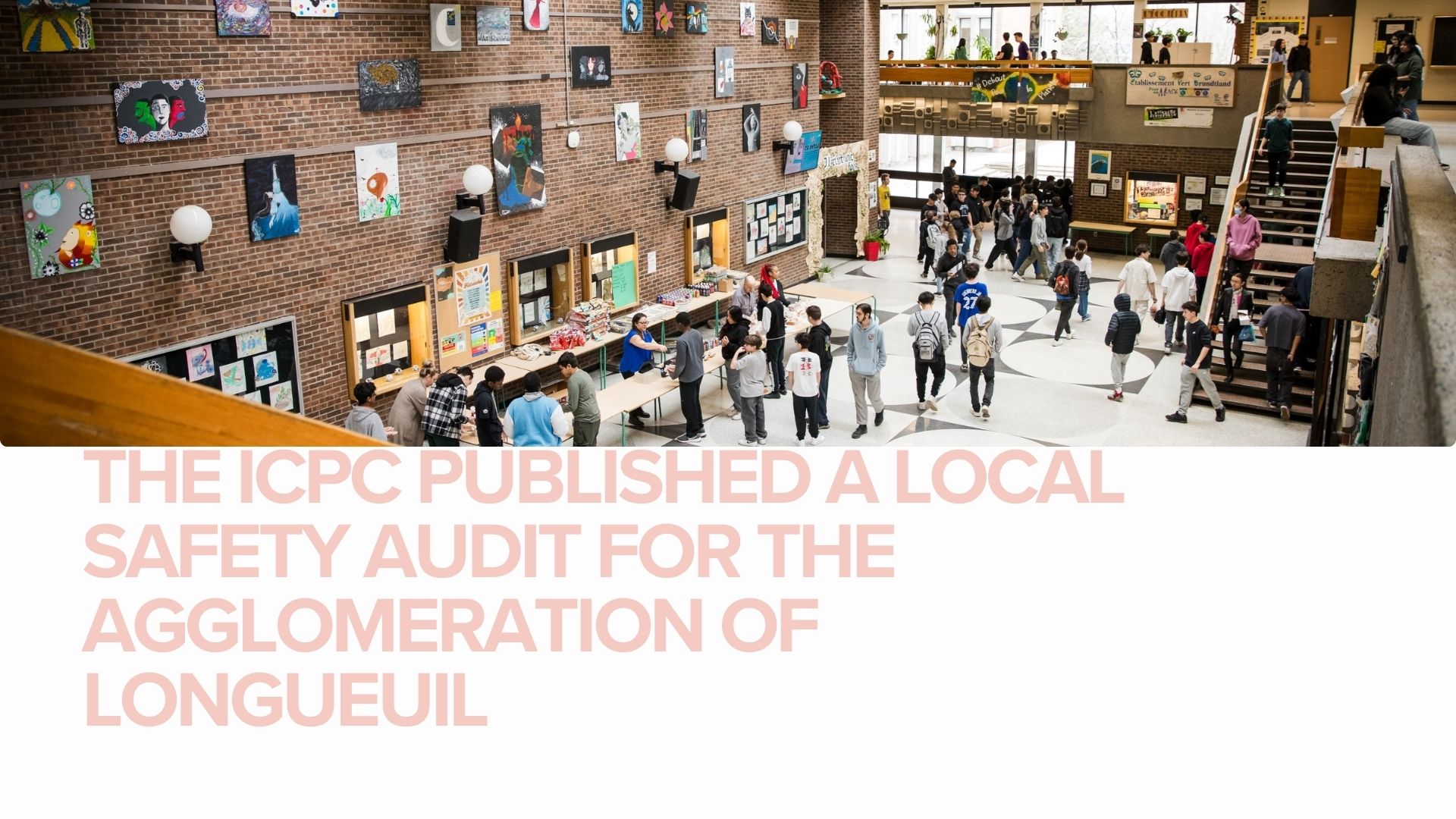

An increasing rate of crimes against the person was observed in the Longueuil agglomeration between 2018 and 2022. Also, over the same period, it was noted that young women were the most numerous victims of crime in private spaces, and that young people aged 12 to 17 accounted for the highest number of victims in schools.
These examples of analyzed observations of crime in the agglomeration have encouraged the need to strengthen collaboration between the various local stakeholders, such as the police, public institutions and community organizations, to put in place coordinated and effective prevention measures. Through the Government of Canada’s Building Safer Communities Fund (BSCF), contributed in part to the Government of Quebec under an agreement, the City of Longueuil appointed the ICPC to support it in conducting a local safety audit. The purpose of this report is to provide an overview of safety among youth in the Longueuil agglomeration and to encourage community participation in safety issues.
Achieved through a collaborative approach favouring positive and sustainable transformation as well as through space syntax approach, the report provides a quantitative analysis based on police data provided by the Urban agglomeration of Longueuil Police Service. The report also presents a qualitative analysis, which was carried out in collaboration with local stakeholders, involving consultative activities with young people in the territory. Finally, the study features concrete recommendations and solutions, appropriate and adapted to local realities, to strengthen and create safer public spaces.
The report is divided into 4 sections:
- An analytical framework, which lays the foundation for the study, addressing urban safety and the space syntax. It also points out the limitations of using police data and quantitative analysis;
- A portrait of crime in living spaces, which provides an overview of crime in the Longueuil agglomeration, detailing alleged perpetrators and victims by crime location, relationships between victims and perpetrators, and the temporality and geography of the crimes, etc.;
- The results of the on-site survey, such as risk factors and the feeling of safety in public spaces in the agglomeration, exploring issues relating to social cohabitation, the school environment, family life and parenting, cyber-violence, etc.;
- Conclusions and possible solutions, in collaboration with youths and local stakeholders, to improve safety, strengthen human and financial resources, coordinate organizational structures, and develop protection strategies for private and public spaces, such as schools and cyberspace.