
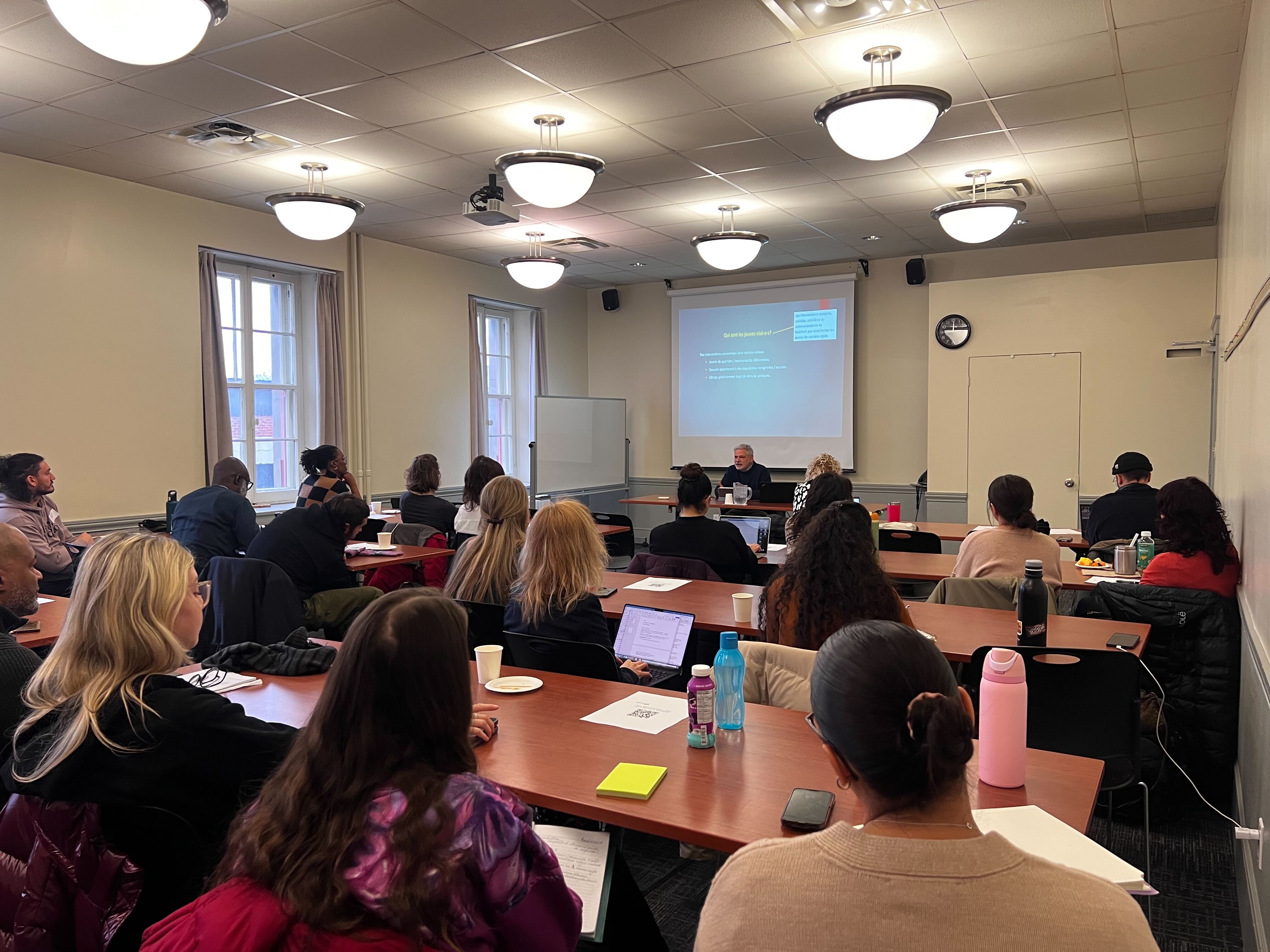
On December 2, 2025, the RÉSAL-Réseau d’échange et de soutien aux actions locales (Local Action Exchange and Support Network) held its final capacity-building activity of the year, funded by Prévention Montréal (City of Montreal). This event, coordinated by the ICPC, was the second edition of a training initially offered last October. The session, held at the Centre St-Pierre in Montreal, focused on the theme “Youth and Police: Understanding and Reducing Cycles of Distrust” with the expertise of Mr. Victor Armony, Full Professor at UQAM and researcher at CRIDAQ.
A space for dialogue and reflection 
Aimed at youth workers, educators, community workers, outreach workers, and professionals working on crime prevention issues, the session addressed persistent tensions between young people and the police. Some participants highlighted challenges related to resource availability and the adaptation of tools to the realities of youth. They expressed an urgent need for institutional and political support to better assist young people.
Key Findings That Stand Out
Discussions revealed several cross-cutting issues:
- Widespread Distrust: A single negative interaction with the police can undo months of relationship-building with youth. Participants emphasized that young people feel underrepresented and lack confidence in institutions, fueling a sense of exclusion. This lack of trust does not only affect youth; it also extends to professionals, who sometimes encounter difficulties in collaborating effectively between institutions.
- Bias and Stereotypes: Certain institutional practices and incomplete data contribute to disproportionately targeting specific neighborhoods or communities. In practical terms, this means that youth from racialized or disadvantaged backgrounds are more closely monitored than others, reinforcing stereotypes and creating an atmosphere of suspicion.
- Invisible Violence: These are not physical acts but include microaggressions (small gestures or comments that demean), ambiguous relationships between youth and institutions, and double victimization. For example, when a discrimination complaint is ignored or minimized, causing the victim to suffer a second injustice. Such situations undermine trust, particularly among racialized young women.
- Lack of Adapted Tools: current systems do not always meet the realities of youth. Participants noted the absence of spaces where young people can express themselves, such as youth committees in certain boroughs. This gap limits their ability to voice needs and develop critical thinking.
- Disconnect Between Police and Communities: Many officers lack a deep understanding of local dynamics, which widens social and cultural gaps. Participants emphasized the need for collaboration without hierarchy among stakeholders: police, schools, community organizations, and social workers working side by side.
- Fragmented Institutional Language: Misunderstandings around terms like “prevention” or “risk” complicate coordination. For example, what the police consider “prevention” may differ from how a community organization interprets it, leading to inconsistent interventions.
These findings show that distrust stems from a combination of individual, institutional, and structural factors.
Moving Forward
The training identified concrete steps: strengthen inter-institutional coordination, create spaces for youth participation, develop adapted tools, and train stakeholders to recognize their biases. Participants emphasized the need for “shared language” and a systemic understanding of relationships between institutions.
ICPC’s Strong Commitment
This session wraps up RÉSAL’s 2024–2025 training series, designed to equip local stakeholders with tools to tackle complex challenges around youth violence. For the ICPC, these initiatives are key to building local capacity and encouraging collaborative, community-driven solutions.